
Understanding the Canton Wallet Gateway
Solving validator‑agnostic signing for institutional tokenization
The Canton Wallet Gateway is a standardized interface that connects Canton dApps and validator nodes to external signing providers. It allows wallets and custody platforms to sign Canton transactions without needing to understand every app and package deployed across all participating validators.
This page describes:
- The problem the Wallet Gateway solves
- The high‑level interaction flow
- How Blockdaemon integrates as a headless signer and policy engine.
Choose Blockdaemon for Canton infra
Problem: fragmented topology and package awareness
In Canton, state is not globally shared. Instead:
- Different validator nodes support different applications and packages
- Parties may operate private validators and networks
- Regulated institutions often need to run their own nodes for compliance reasons.
Without a gateway, a signing provider would need to:
- Maintain awareness of all packages and apps used across all validators its customers might touch
- Construct transactions in the correct format for each validator and app combination.
This model does not scale: the potential set of validators and packages is open‑ended, and institutions may deliberately keep some packages private. It also couples the signer tightly to specific validators, which conflicts with institutional requirements for validator independence and private deployments.
The Wallet Gateway solves this by standardizing how prepared Canton transactions are passed from validators to signers.
Concept: Wallet Gateway as Canton’s signing interface
Conceptually, the Wallet Gateway plays a similar role to WalletConnect on public chains: it defines a common interface between applications and wallets. However, in Canton it is focused on:
- Handling prepared submissions produced by validators
- Decoupling the signer from validator and package specifics
- Supporting private validators and networks.
Key properties:
- Standardized interface: dApps and validators send prepared submissions in a common format that any conformant signer can consume.
- Full transaction context: the interface ensures the signer receives both the prepared transaction and its hash, enabling clear signing.
- Validator‑agnostic: the signer does not need to know which validator produced the transaction or which apps it supports.
The Wallet Gateway is not tied to a single vendor. Multiple providers, including Blockdaemon and Fireblocks, can implement the interface so that Canton applications can integrate with their signing and custody services.
Interaction Flow
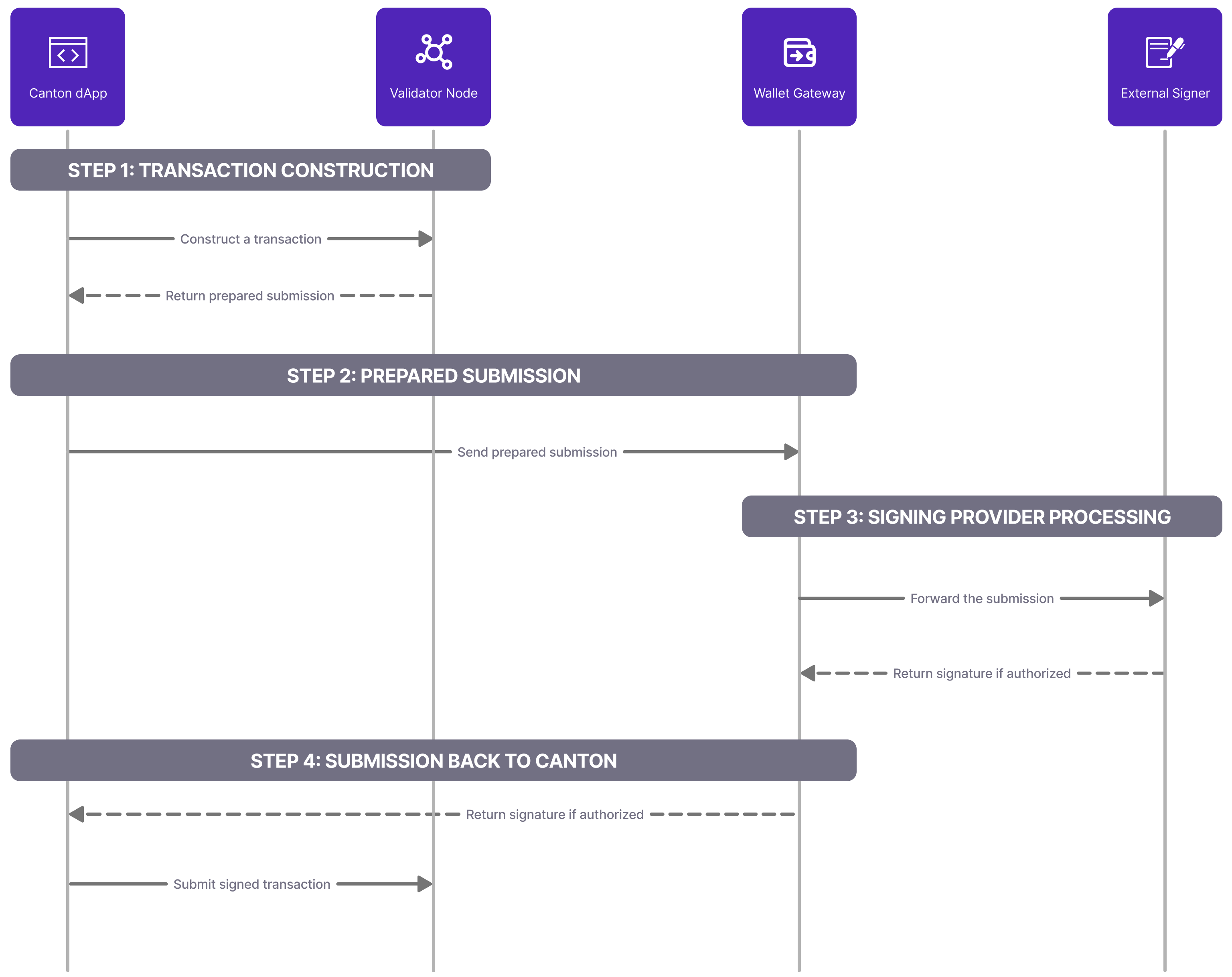
At a high level, the interaction flow is:
-
Transaction construction
- A Canton dApp interacts with one or more validator nodes to construct a transaction for a given workflow (for example, a token transfer or allocation).
- The validator assembles the required metadata, identifiers, and application logic into a prepared submission.
-
Prepared submission
- The prepared submission contains both the prepared transaction and a prepared transaction hash.
- The Wallet Gateway exposes an interface that delivers this prepared submission to the selected signing provider.
-
Signing provider processing
- The signer receives the full prepared transaction and hash.
- It parses the transaction, applies internal policy and governance checks, and may run its own approval workflows.
- If the transaction passes all checks, the signer produces and returns a signature.
-
Submission back to Canton
- The dApp (or an associated service) receives the signature and submits the fully signed transaction to the appropriate validator node.
- The signer remains unaware of which validator or network will ultimately process the transaction.
This architecture allows:
- Multiple validators and apps to coexist, including private deployments
- Multiple signers to implement the same interface
- dApps to change validator or signer without rewriting business logic.
Blockdaemon integration
Blockdaemon implements the Canton Wallet Gateway interface as a headless, API‑driven signer backed by its institutional wallet platform.
When used with Blockdaemon:
- Canton dApps and validators send prepared submissions to Blockdaemon via the Wallet Gateway interface.
- Blockdaemon’s wallet platform receives the prepared transaction and hash, parses the full transaction payload, and applies policies and governance.
- Policy checks can include approvals, limits, threshold signing, and other institutional controls.
- If approved, Blockdaemon signs the transaction and returns the signature through the same interface.
Notable characteristics:
- Headless operation: integration is via API; you are not required to use a specific frontend.
- Clear signing: Blockdaemon validates and displays the contents of the prepared transaction, avoiding blind signing based only on hashes.
- Validator and network agnosticism: Blockdaemon does not need to know which validator or network you use, and can support private validators and networks without special case development.
This allows institutions to:
- Use Blockdaemon as a centralized custody and policy engine for Canton assets
- Run their own Canton validators, or use validator‑as‑a‑service from Blockdaemon or others
- Integrate Canton tokenization flows into existing operational systems via APIs.
Choose Blockdaemon for Canton infra
When to use the Wallet Gateway
You should consider using the Canton Wallet Gateway when:
- Your application needs to support multiple institutional participants that may run their own validators.
- You require an external, policy‑rich signing provider rather than application‑embedded keys.
- You expect to integrate with more than one wallet or custody provider over time.
- You operate private validators or networks and want to keep them decoupled from the signer.
For details on integrating with Blockdaemon’s implementation of the Canton Wallet Gateway, including API endpoints and configuration, refer to the Blockdaemon Canton wallet and signer documentation or contact Blockdaemon support.
Related documentation
- Canton Main Page: Learn about our Canton offerings
- Canton Overview: High-level overview of the Canton Network architecture, concepts, and infrastructure components.
- Canton Validator: High-level overview of Canton validators and why they matters for institutions
- Canton Super Validator: Role of Super Validators, how they operate the Global Synchronizer, and how they differ from standard validators.
- How Canton Works: Learn how Canton’s subnets, privacy, and atomic settlement work for regulated financial applications.
- How to Reduce Canton Onboarding Complexity: See how institutions can onboard to Canton faster with managed validators and MPC-secured wallets.
- How to Safeguard Privacy in Canton Transactions: Discover how Canton ensures strong privacy using Daml permissions and MPC key controls.
- Canton: How to Overcome Regulatory and Operational Obstacles: Learn how institutions can meet compliance and operational demands when building on Canton.
👋 Need Help?
Contact us through email or our support page for any issues, bugs, or assistance you may need.
Updated 7 months ago